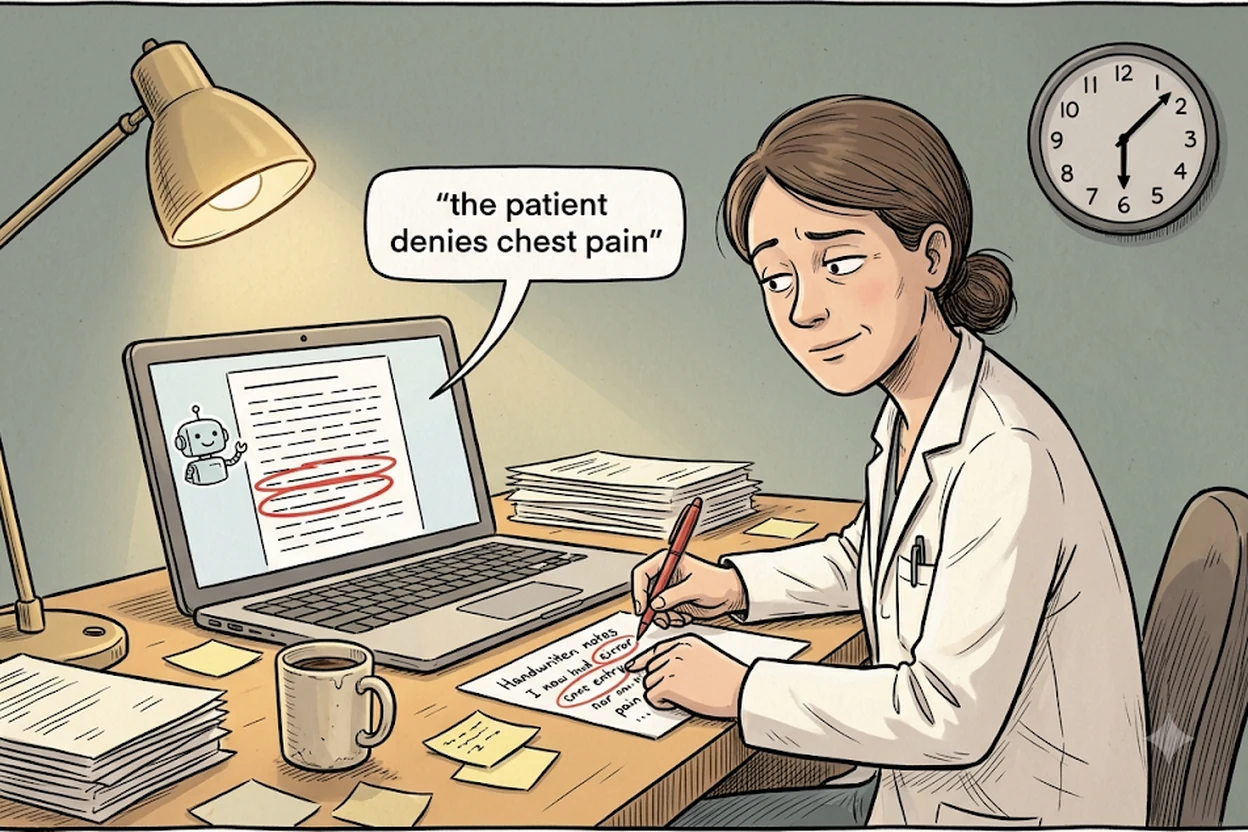
AI tools are spreading through healthcare faster than the supply of medical experts able to clinically validate their output. But like any new technology, AI's error rate is high: Mayo Clinic Proceedings: Digital Health found that AI scribe-generated notes averaged 3 errors per case with potential for moderate-to-severe patient harm.
What is clinical validation?
Clinical validation is the process of manually confirming that AI output is accurate, complete, and clinically appropriate, before it enters the medical record or informs a care decision. Effective validation packages feedback in such a way that it trains the underlying model, helping it become more accurate over time.
For example: validating an AI scribe means comparing the model's note to what was actually said, and providing feedback in a way the model can easily digest.
How many samples are enough?
While there is no industry standard on optimal sample size, it is reasonable to target the known error rates of similar, mature models. AI scribes, for example, carry an estimated 7% mischaracterization rate.
We recommend:
- Pre-launch, validate 100% of outputs to establish a baseline error rate. Medical specialties each carry their own nuances, so focus on maximizing volume of samples, each with a high quality level of review.
- Post-launch, validate 100% of high risk categories (e.g. pediatric mental health), since they directly impact high impact treatment decisions. Completely trusting AI in these scenarios carries real human safety risk.
- Post-launch, 300 cases per month is statistically significant for low risk categories. This number need not increase as you scale.
We derive this number using the aforementioned AI scribe's 7% baseline error rate, coupled with standard statistical boundaries of a 95% confidence and 5% margin of error.
Who is qualified to validate?
AI presents mistakes with confidence, and often fails to flag mistakes as low confidence. To optimize quality of review, and ensure that contextual nuances are equally considered, auditors should be medically trained and fluent in the case language. Onshore clinicians are a popular choice for validation, but their scarcity makes such reviews slow and expensive.
Our offshore nurses are trained in clinical validation of AI outputs, including:
- Hallucinations — an exam, symptom, or medication that was never mentioned
- Omission — clinically relevant details don't make it into the output
- Misattribution — details get assigned to the wrong patient, provider, or timing
- Contextual misinterpretation — grasping situational nuances, such as intent
Responsible AI validation requires
- Complete human review. The entire output checked for completeness and accuracy.
- Paper trail. Timestamped records of what a human reviewed and changed.
- Cross-checking against the source of truth. Content should be reconciled against the existing medical record(s).
The liability reality
"AI got it wrong" is not a defense. It is the signing clinician — not the AI vendor — who bears primary liability for what ends up in the chart. AI-hallucinated documentation has led to over 700 court cases with no signs of slowing down.
The bottom line
AI can meaningfully reduce healthcare burden. But responsible adoption requires meaningful clinical review, and right now, most organizations are deploying code faster than they're reviewing the outputs.
To better understand how we can help, reach out.
This article is for general informational purposes and does not constitute legal, regulatory, or clinical advice. Please excuse typos.. this was not written by AI :)